
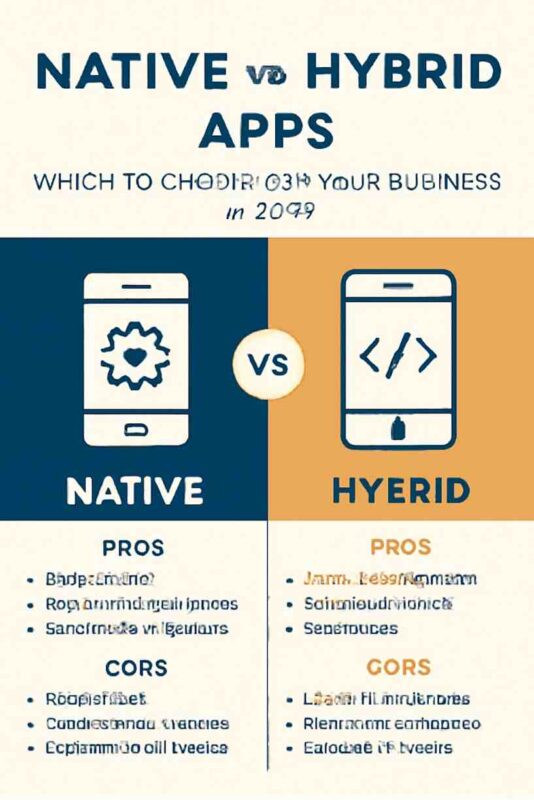
One of the most crucial decisions you will have to make in 2025 when creating a mobile application for your business is whether to make a hybrid or native app.
Should we build a native app or a hybrid app?
The technology you select will affect your app’s price, time-to-market, performance, user experience, and long-term maintainability.
This article will explain the differences between native and hybrid apps, compare their advantages and disadvantages, and help you choose the one that best meets your needs.
✅ What is a Native App?
For a single platform (iOS or Android), a native application is made using platform-specific languages and tools:
-
iOS: Swift or Objective-C, built with Xcode
-
Android: Kotlin or Java, built with Android Studio
These apps are downloaded directly from app stores and have full access to the device’s hardware, including the camera, GPS, and sensors.
✅ What is a Hybrid App?
A hybrid application uses web technologies (HTML, CSS, and JavaScript) and is wrapped in a native container so that it can run on both platforms with a single codebase.
Popular hybrid frameworks in 2025 include:
-
Flutter (Google-backed)
-
React Native (Facebook-backed)
-
Ionic
-
Capacitor
These frameworks allow for native code compilation and faster cross-platform development.
⚖️ Native vs. Hybrid: Comparison Table
| Feature | Native Apps | Hybrid Apps |
|---|---|---|
| Performance | Best-in-class | Slightly slower |
| User Experience | Seamless and fluid | Close, but may have limitations |
| Time to Market | Longer (two separate builds) | Faster (single codebase) |
| Development Cost | Higher | Lower |
| Access to Hardware | Full access | Limited to plugins/APIs |
| Maintenance | Complex (two platforms) | Easier (shared updates) |
| Custom Features | Fully supported | May require native modules |
| App Size | Leaner | Can be heavier |
🔍 Pros & Cons
✔️ Native Apps – Pros:
-
Top performance and speed
-
Full use of platform APIs
-
Superior animations and transitions
-
More stable on complex apps
-
Better long-term scaling
❌ Native Apps – Cons:
-
Higher development cost (2 apps)
-
Slower to launch
-
Requires separate teams (iOS and Android)
✔️ Hybrid Apps – Pros:
-
Faster development and launch
-
One team, one codebase
-
Lower upfront cost
-
Easy to update and maintain
-
Ideal for MVPs and startups
❌ Hybrid Apps – Cons:
-
Slightly reduced performance
-
Might struggle with complex UI
-
Dependence on third-party plugins
-
Not all hardware features may be fully supported
🧠 When to Choose Native
Choose native development if:
-
You’re creating a feature-rich or high-performance application (such as games or real-time apps).
-
You want full control over user experience and platform-specific UI.
-
You have the budget for a long-term investment.
-
Security and responsiveness are top priorities.
🚀 When to Choose Hybrid
Go for a hybrid app if:
-
You want a faster and more affordable route to market.
-
Your application is either form-driven or content-based (e.g., e-commerce, booking apps, loyalty apps).
-
You need to test the market with an MVP.
-
You’re working with a lean team or startup budget.
💼 Business Examples
Native App Example:
A fintech startup is developing a sophisticated real-time trading platform that features push notifications, native animations, and fingerprint login.
Hybrid App Example:
An app for class reservations, subscriptions, and client reminders is being released by a fitness centre; it was created in less than three months using Flutter.
🌍 What About PWAs in 2025?
PWAs, or progressive web apps, have significantly improved. Although they mimic native behaviour (offline access, home screen install), they operate within browsers. Although they aren’t always as good as native apps, they are ideal for web-first startups, internal tools, and lightweight apps.
🔐 Compliance and Security
Advanced security features (like biometric login or secure storage) are frequently more directly accessible in native apps. Although they need more stringent coding guidelines and updated plugins, hybrid apps can still be secure.
When selecting your architecture, take GDPR, data encryption, and platform-level security APIs into consideration if your company handles sensitive data (finance, health, etc.).
🧭 Conclusion: Which One is Right for You?
There’s no one-size-fits-all answer. The right choice depends on your:
-
Budget
-
Timeframe
-
User needs
-
App complexity
-
Long-term vision
📌 In short:
-
For high performance and scalability → Go Native
-
For speed, flexibility, and MVPs → Go Hybrid
-
For content and desktop-mobile alignment → Consider a PWA
Do you need assistance making a decision? Whether your idea is native or hybrid, Usk Digital can assist you in assessing, designing, and constructing the best solution.