
Choosing the best software development partner is one of the most important choices you will have to make when starting a business. The success of your project is directly impacted by the calibre of your development team, regardless of whether you’re creating a custom enterprise solution, a mobile app, or a web application.
The field of software development has become increasingly complicated in 2025, offering a wide range of choices from independent contractors to major agencies. In order to keep your project on schedule, within budget, and in line with your long-term goals, this article will walk you through the process of selecting the ideal partner.
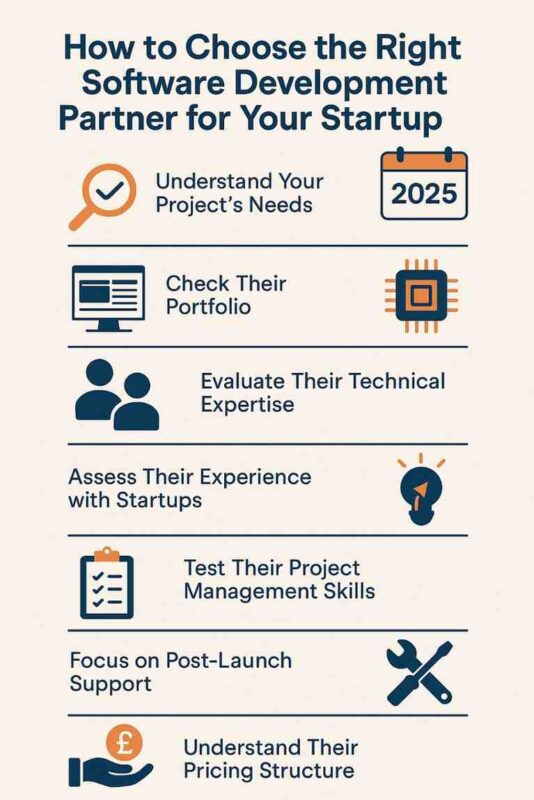
✅ 1. Understand Your Project’s Needs
You must define your project before you can start looking for a partner. What sort of software are you developing? Are you creating an enterprise solution, a web-based platform, or a mobile application? Clearly define your needs so that you can find a development partner who shares them.
Key questions to ask:
-
Which platform or platforms—iOS, Android, or the web—do you require support for?
-
Which frameworks and technologies—such as React, Laravel, and Flutter—do you wish to use?
-
Will the project require complex integrations (e.g. CRM, ERP, payment systems)?
Do you require a development team for coding alone, or do you require a full-service partner (design, development, testing)? Finding the ideal fit will be made easier by clearly defining the scope.
✅ 2. Check Their Portfolio
One of the best measures of a software development partner’s competence is a robust portfolio. Seek out samples of their prior work, particularly on projects that are comparable to yours. The portfolio ought to contain:
-
Case studies showcasing how they approached challenges.
-
Technologies used in past projects.
-
User testimonials or feedback on their work.
Red flags to watch for:
-
Generic portfolios that lack detail or don’t align with your industry.
-
a lack of project diversity. Experience in multiple fields, rather than just one, is what makes a good partner.
✅ 3. Evaluate Their Technical Expertise
A variety of technical skills are needed for software development. Make sure your partner is knowledgeable about the particular technologies that are relevant to your project.
Key points to consider:
-
Tech Stack: Are they proficient in the languages and frameworks you want to use?
-
Development Methodologies: Do they adhere to Scrum or Agile? These approaches enable flexibility and frequent iterations, which makes them ideal for startups.
-
Quality Assurance: Do they have a strong automated and manual testing procedure in place to guarantee a launch free of bugs?
By looking over any technical blogs, white papers, or open-source projects they have contributed to, you can confirm their level of expertise. They are likely current if they frequently write about new technologies or participate in open-source communities.
✅ 4. Consider Communication & Cultural Fit
A successful partnership requires effective communication. It’s important to evaluate your communication and teamwork skills because you’ll probably be working with your development partner for a long time.
Things to look for:
-
Responsiveness: How fast do they reply to emails or meeting requests? Later problems may arise from delayed communication.
-
Clarity in Communication: Can they communicate complex ideas in a way that is easy to understand?
-
Cultural Alignment: Do you share the same values as their workplace culture? In the long run, it makes a significant difference to work with a partner who shares the values of your startup.
✅ 5. Assess Their Experience with Startups
Startups frequently encounter particular difficulties, such as limited funds, short turnaround times, and the requirement for quick iterations. Your software development partner must therefore have prior startup experience.
Questions to ask:
-
Have they worked with startups before?
-
Do they understand the challenges startups face?
-
Do they have the flexibility to change deadlines and financial restrictions?
Working with a development team with startup experience guarantees that they are aware of the importance of cost-effectiveness and agility.
✅ 6. Test Their Project Management Skills
To guarantee that your software is developed on schedule, within budget, and to the necessary quality standards, effective project management is essential. A competent software development partner will have a well-defined project management procedure.
Look for:
-
Project timelines: Do they provide clear timelines with milestones and deadlines?
-
Risk management: How do they handle delays, bugs, or scope changes?
-
Progress tracking: Will they provide regular updates on development progress?
Well-known project management platforms such as Basecamp, Trello, or Jira facilitate efficient task management and communication.
✅ 7. Focus on Post-Launch Support
Developing the software is only the first step. Your app will require routine upkeep, updates, and bug fixes following launch. A competent partner will support you continuously to keep your software updated in addition to helping you during the development stage.
Key considerations:
-
Bug Fixing & Updates: What kind of post-launch support do they offer? Can they fix bugs or add features after launch?
-
Scalability: Can they help scale the product as your business grows?
-
Training: Do they provide documentation and training for your internal team to maintain the software?
✅ 8. Understand Their Pricing Structure
Although cost is always important, it shouldn’t be the sole factor taken into account. Instead of just going for the cheapest price, pick a partner who provides value for the money. Pricing models may vary amongst partners:
-
Hourly rates: Ideal for smaller projects or short-term engagements.
-
Fixed-price contracts: Best for well-defined, clear projects.
-
Retainers: Great for long-term relationships with ongoing needs.
Make sure there are no unforeseen expenses and that the pricing structure fits the scope of your project.
🧠 End
For your startup to succeed in the long run in 2025, picking the right software development partner is crucial. Choose a partner who shares your objectives, has the necessary technical know-how, is flexible, and is dedicated to open communication and post-launch assistance.
Take your time choosing a partner who will support your startup’s expansion and success in the cutthroat digital market.