
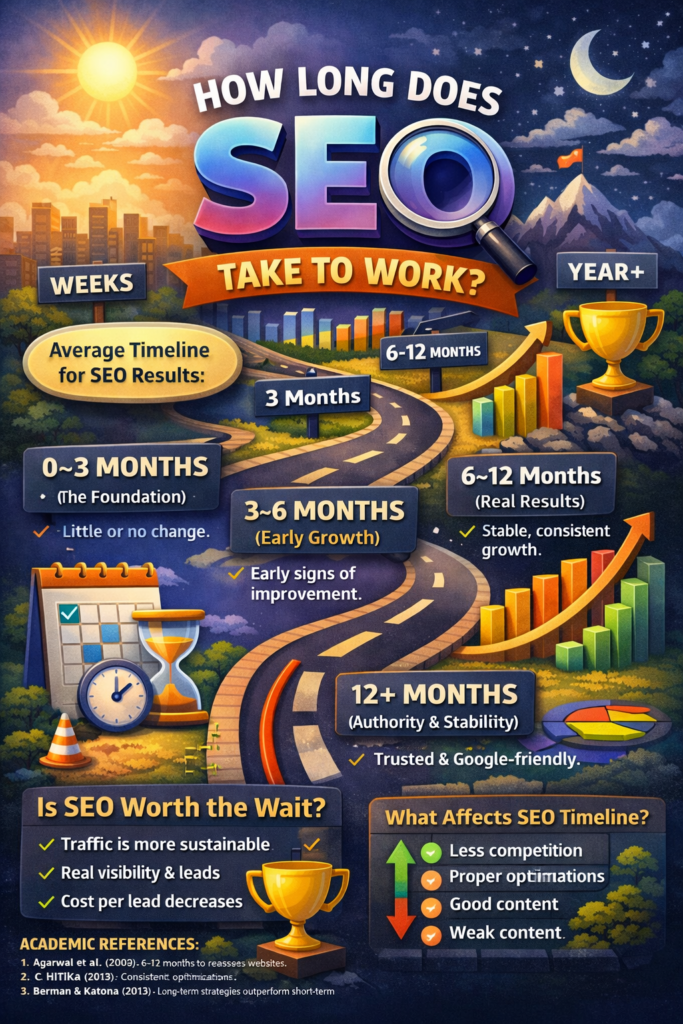
How Long Does SEO Take to Work?
If you’ve recently invested in SEO (Search Engine Optimisation), one of the first questions you’re likely to ask is:
“How long will it take to see results?”
This is a very common and reasonable question. The honest answer is simple:
SEO does not work instantly. It takes time, consistency, and patience.
In this post, we review how long SEO usually takes to work, and why it takes time, and what you should expect at each stage. This guide is written for non-technical readers, so no specialist knowledge is required.
What Does It Mean for SEO to “Work”?
Before talking about timelines, it’s important to understand what “SEO working” actually means.
For different businesses, SEO success can mean different things, such as:
- More visitors coming to your website
- Higher rankings on Google
- More phone calls or enquiries
- Increased sales or leads
In reality, SEO improves these results gradually. It works step by step rather than delivering instant results.
How Long Does SEO Take? (An Honest Timeline)
For most websites, SEO follows a predictable pattern:
- 0–3 months: Little or no visible change
- 3–6 months: Early signs of improvement
- 6–12 months: Stronger and more consistent results
- 12+ months: Long-term growth and authority
This timeline is not just based on agency experience. It is also supported by academic research and SEO performance studies.
Why Does SEO Take So Long?
Search engines like Google do not trust website changes immediately.
When you improve your website, Google needs time to:
- Discover your pages (known as crawling)
- Understand what your content is about
- Compare your site with competitors
- Decide whether your website deserves higher rankings
SEO is best compared to building a reputation, not running paid advertising.
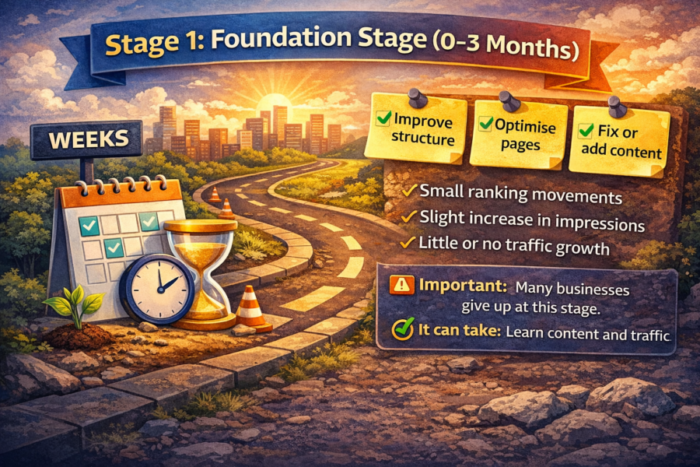
Foundation Stage
Stage 1: Foundation Stage (0–3 Months)
During the first few months, SEO work focuses on building strong foundations, including:
- Improving website structure
- Optimising important pages
- Fixing or adding content
- Resolving technical SEO issues
What you may notice at this stage:
- Small ranking movements
- Slight increase in impressions on Google
- Little or no traffic growth
Important: Many businesses give up at this stage, which is usually a mistake.
Academic research shows that search engines require time to reassess websites after changes are made (Agarwal et al., 2009).
Stage 2: Early Growth Stage (3–6 Months)
This is when SEO often starts to show early results.
You may begin to see:
- Some keywords moving onto page one or two
- More visitors arriving from search engines
- Your first enquiries generated from organic search
At this stage, Google is effectively testing your website against competitors.
SEO studies suggest rankings usually do not stabilise until consistent optimisation has been applied over several months (Chitika, 2013).
Stage 3: Real Results Stage (6–12 Months)
This is where SEO becomes more reliable and valuable.
Typical results include:
- Stable page-one rankings for selected keywords
- Noticeable traffic growth
- Regular enquiries or leads
- Higher trust from users
Research indicates that websites consistently producing quality content and building authority outperform short-term SEO approaches (Berman & Katona, 2013).
SEO also begins to compound, meaning each improvement strengthens future performance.
Stage 4: Authority & Stability (12+ Months)
After one year of consistent SEO effort:
- Google trusts your website more
- New content ranks faster
- SEO becomes more cost-effective to maintain
- Competitors find it harder to overtake you
This is why SEO is widely considered a long-term investment rather than a quick marketing tactic.
What Factors Speed Up or Slow Down SEO?
SEO Can Be Faster If:
- Your website is new but well built
- Competition is low
- Your content is high quality
- SEO is done correctly and consistently
SEO Can Take Longer If:
- Your industry is highly competitive
- Your website has technical problems
- Poor SEO was done in the past
- Your content is weak or duplicated
Is SEO Worth Waiting For?
Yes — because SEO behaves very differently from paid advertising:
- SEO does not stop when payments stop
- Traffic is more stable and trustworthy
- Long-term cost per lead is lower
- Results improve over time
This is why many successful businesses invest in SEO early and maintain it consistently.
Final Honest Answer
If you expect SEO to work in a few weeks, it may not be the right strategy.
However, if you want:
- Long-lasting traffic
- Steady business growth
- Real online visibility
Then SEO is one of the most effective long-term investments you can make.
Academic References
- Agarwal, A., Hosanagar, K., & Smith, M. D. (2009). Location, location, location: An analysis of profitability of position in online advertising markets. Journal of Marketing Research.
- Chitika. (2013). The Value of Google Result Positioning. Chitika Insights Research.
- Berman, R., & Katona, Z. (2013). The role of search engine optimization in search marketing. Marketing Science.